
Severity levels
Each vulnerability is assigned a severity level based on its CVSS (Common Vulnerability Scoring System) score, as published by NIST’s National Vulnerability Database (NVD). These levels help you prioritize based on potential impact:- Critical Immediate and significant threats, often exploitable. Require urgent attention and remediation.
- High Severe risks that could lead to major impact. Require prompt action.
- Medium Issues with moderate impact. Should be remediated within a reasonable timeframe.
- Low Minimal impact or unlikely to be exploited. Still recommended to resolve.
Overview tab
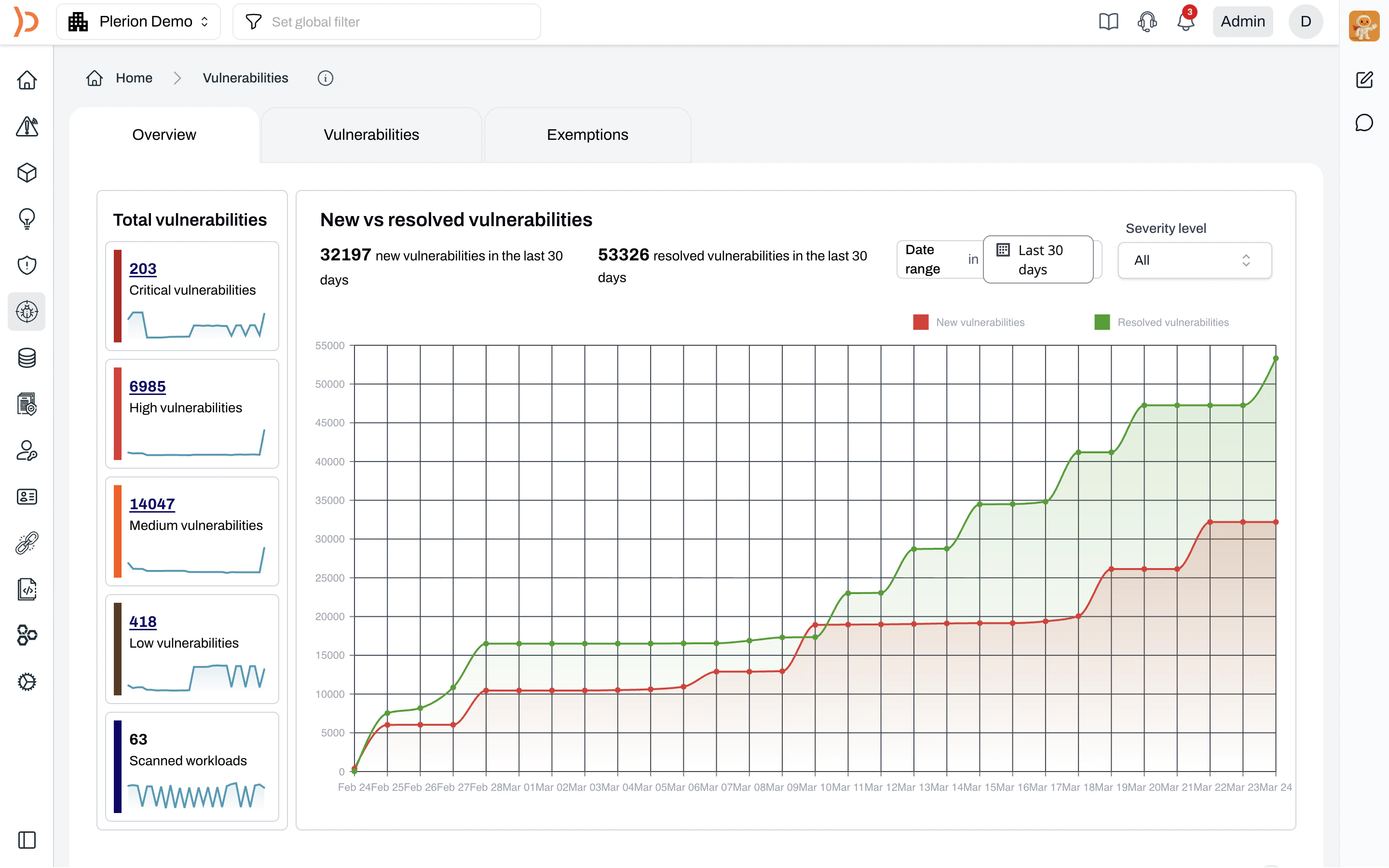
The Overview tab provides a high-level summary of your vulnerability posture across all scanned workloads.Total vulnerabilities
The left panel shows the current count of vulnerabilities broken down by severity — Critical, High, Medium, and Low — along with a sparkline trend for each. The total number of scanned workloads is also displayed at the bottom.New vs resolved vulnerabilities
The main chart tracks the trend of new and resolved vulnerabilities over time. You can adjust the date range (last 30 days by default) and filter by severity level using the dropdowns above the chart. The red line represents new vulnerabilities detected and the green line represents resolved vulnerabilities.Top vulnerabilities
Below the chart, the Top vulnerabilities section lists the most significant vulnerabilities across your environment. Each entry shows:- The CVE ID and description
- Severity level
- The affected asset, including provider, integration, region, and asset group
- Context badges such as Publicly exposed, Exploited vulnerability, CVSS exploitable, and Fixable
Vulnerabilities tab
The Vulnerabilities tab lists all detected vulnerabilities across your scanned workloads, with options to group, filter, and take action.Grouping
You can group vulnerabilities by None, Vulnerability, Provider, Integration, Asset group, Resource type, Asset, or Severity. When grouped by Vulnerability, each row shows the CVE ID, description, severity, and the number of affected assets. Click the expand arrow to see individual affected assets.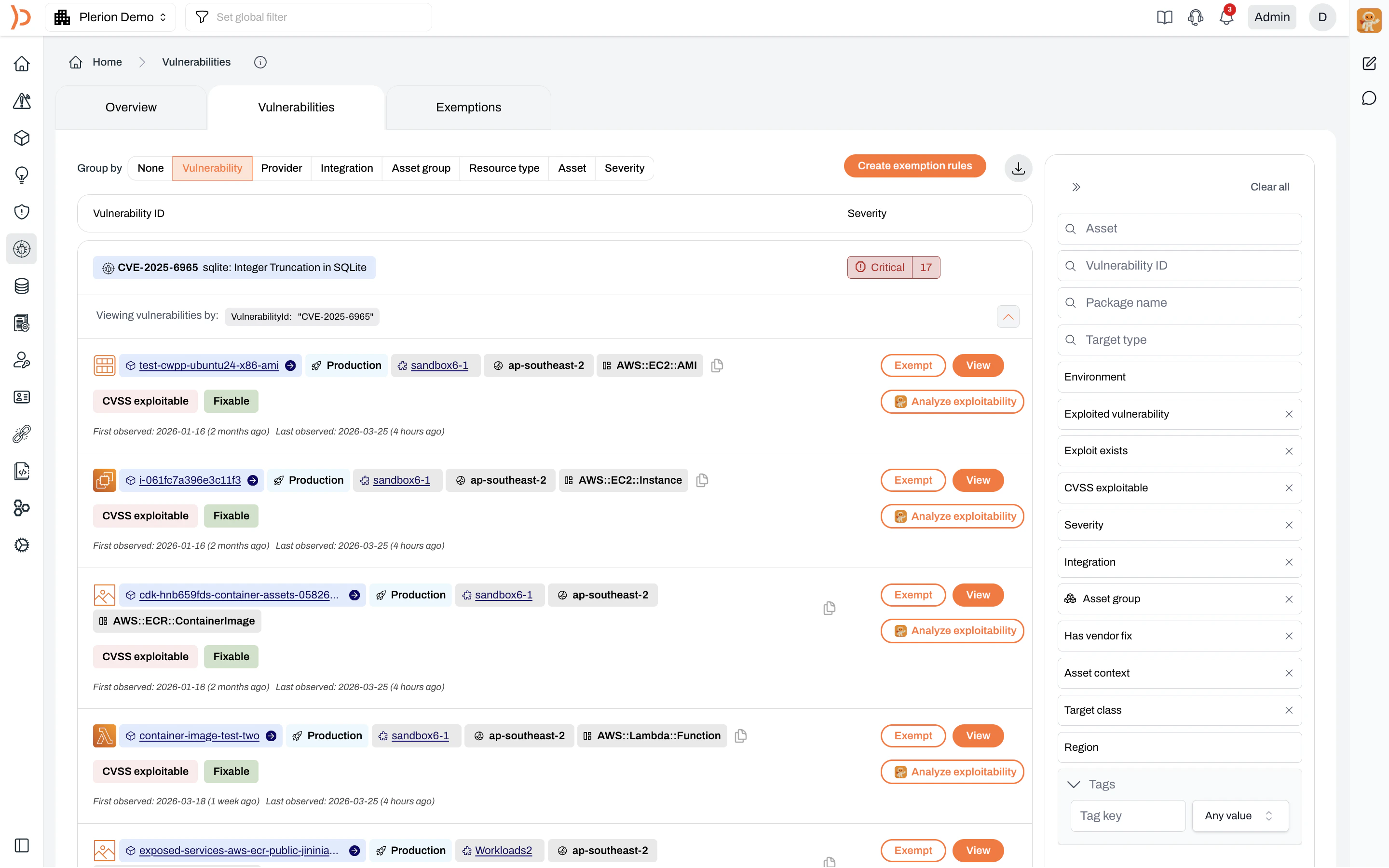
Filtering
Use the filter panel on the right to narrow results by:- Asset: Search by asset name
- Vulnerability ID: Search by CVE ID
- Package name: Filter by affected package
- Target type: Filter by package ecosystem
- Environment: Production or Non-production
- Exploited vulnerability: Whether the vulnerability is known to be exploited in the wild
- Exploit exists: Whether a public exploit exists
- CVSS exploitable: Whether the vulnerability is CVSS exploitable
- Severity: Critical, High, Medium, or Low
- Integration: Your connected cloud environments
- Asset group: Asset groups you have created
- Has vendor fix: Whether a fixed version is available from the vendor
- Asset context: e.g., publicly exposed
- Target class: e.g., os-pkgs, lang-pkgs
- Region: Cloud provider regions
- Tags: Filter by tag key and value
Download
Click the download icon at the top right of the vulnerabilities list to export results as a CSV file.Actions per vulnerability
Each vulnerability row includes action buttons:Exempt: Open the exemption modal for this specific vulnerability and assetView: Open the vulnerability detail panelAnalyze exploitability: Ask Pleri to assess whether this vulnerability is exploitable in your specific environment
Vulnerability details
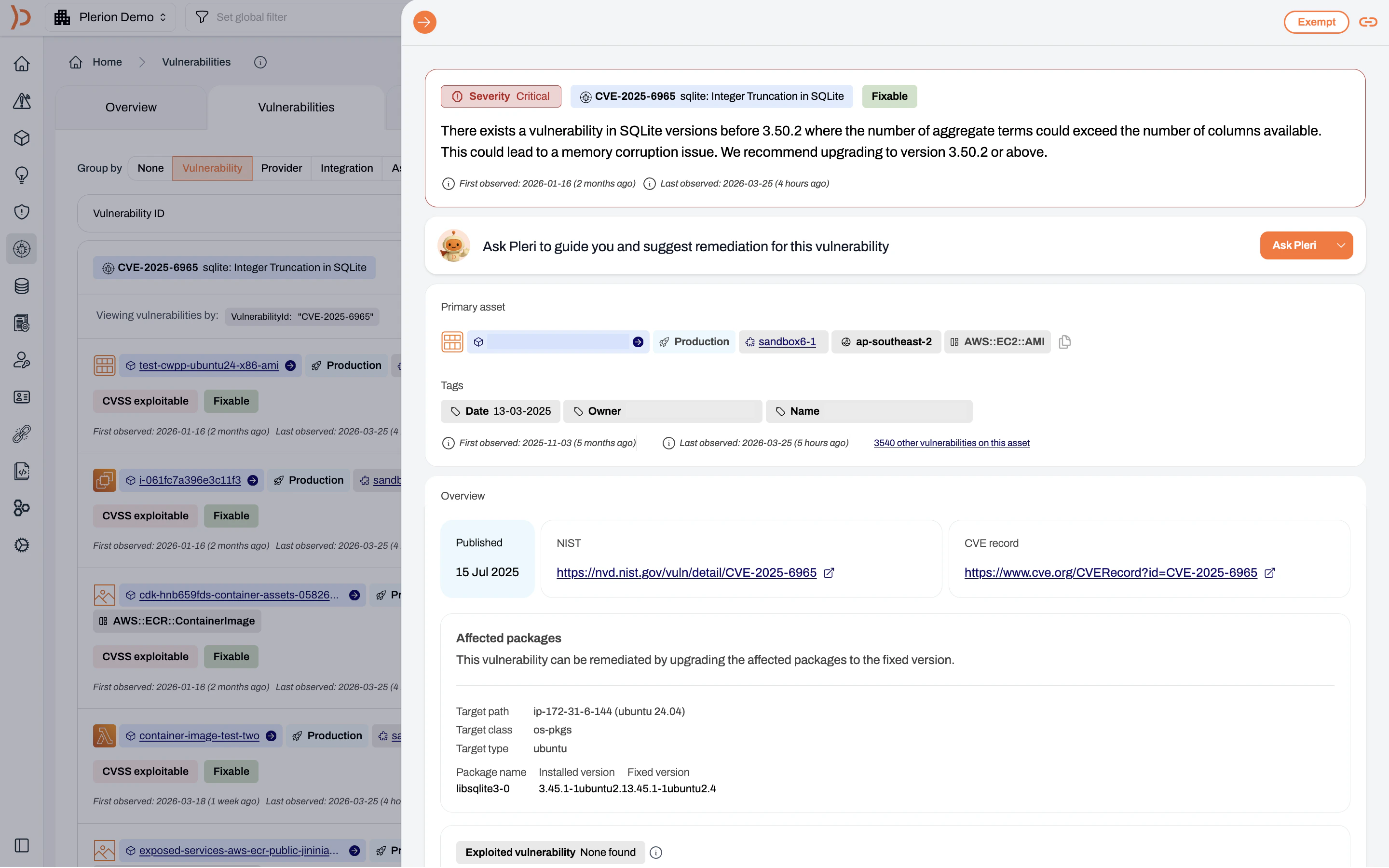
ClickView on any vulnerability to open a detailed side panel with full context:
- Severity and status The CVE ID, description, severity level (Critical, High, Medium, or Low), and whether a vendor fix is available (Fixable badge). First and last observed dates are also shown.
-
Remediation guidance with Pleri
Click
Ask Plerito get step-by-step remediation guidance and suggestions tailored to the vulnerability and affected asset - Primary asset The affected resource, including the asset name, environment, asset group, region, and resource type (e.g., AWS::EC2::AMI, AWS::ECR::ContainerImage).
- Tags Metadata associated with the asset, such as date, owner, and name.
- Overview The published date, links to the NIST National Vulnerability Database entry and the CVE record.
-
Affected packages
Details about the vulnerable package, including:
- Target path: The scan target (e.g., ip-172-31-6-144 (ubuntu 24.04))
- Target class: The package class (e.g., os-pkgs)
- Target type: The package ecosystem (e.g., ubuntu)
- Package name: The affected package
- Installed version: The currently installed version
- Fixed version: The version that resolves the vulnerability
- Exploited vulnerability Indicates whether the vulnerability is known to be exploited in the wild.
Exemptions tab
The Exemptions tab displays all vulnerabilities that have been exempted, whether individually or through exemption rules. Use this tab to review, manage, and audit your exemptions.Exempting vulnerabilities
You can exempt vulnerabilities that are acceptable risks, mitigated by compensating controls, have no vendor fix available, or are not in use.Your asset risk score may change after the next scan due to an exemption.
Exempting an individual vulnerability
1
On the Plerion dashboard, go to the Vulnerabilities dashboard > Vulnerabilities tab
2
Click Exempt on the vulnerability you want to exempt
Click the 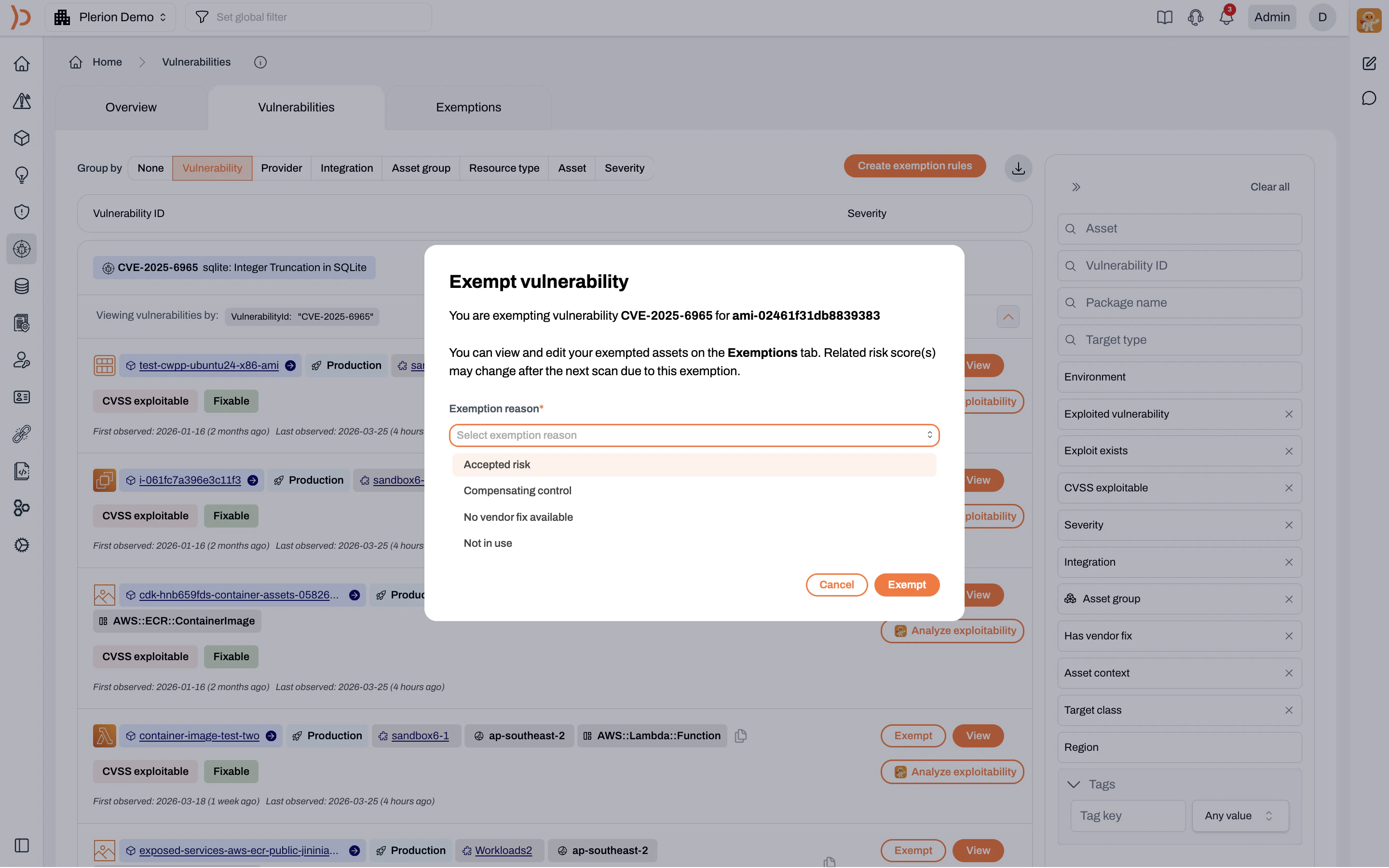
Exempt button on the row for the specific vulnerability and asset combination. This opens the Exempt vulnerability modal.3
Select an exemption reason
Use the Exemption reason dropdown to select one of the following:
- Accepted risk: The vulnerability has been reviewed and the risk is accepted
- Compensating control: Other controls mitigate the risk
- No vendor fix available: No patch or update is available from the vendor
- Not in use: The affected package or component is not actively used
4
Confirm the exemption
Click
Exempt to confirm. The exemption takes effect after the next scan.- You can view and manage exempted vulnerabilities on the Exemptions tab.
- Related risk scores may change after the next scan due to this exemption.
Creating exemption rules
For recurring exemptions, you can create exemption rules at the profile level. These rules automatically exempt any vulnerability that matches the defined conditions, so you don’t need to exempt each occurrence individually.1
Go to the Vulnerabilities dashboard and click Create exemption rules
On the Vulnerabilities tab, click the 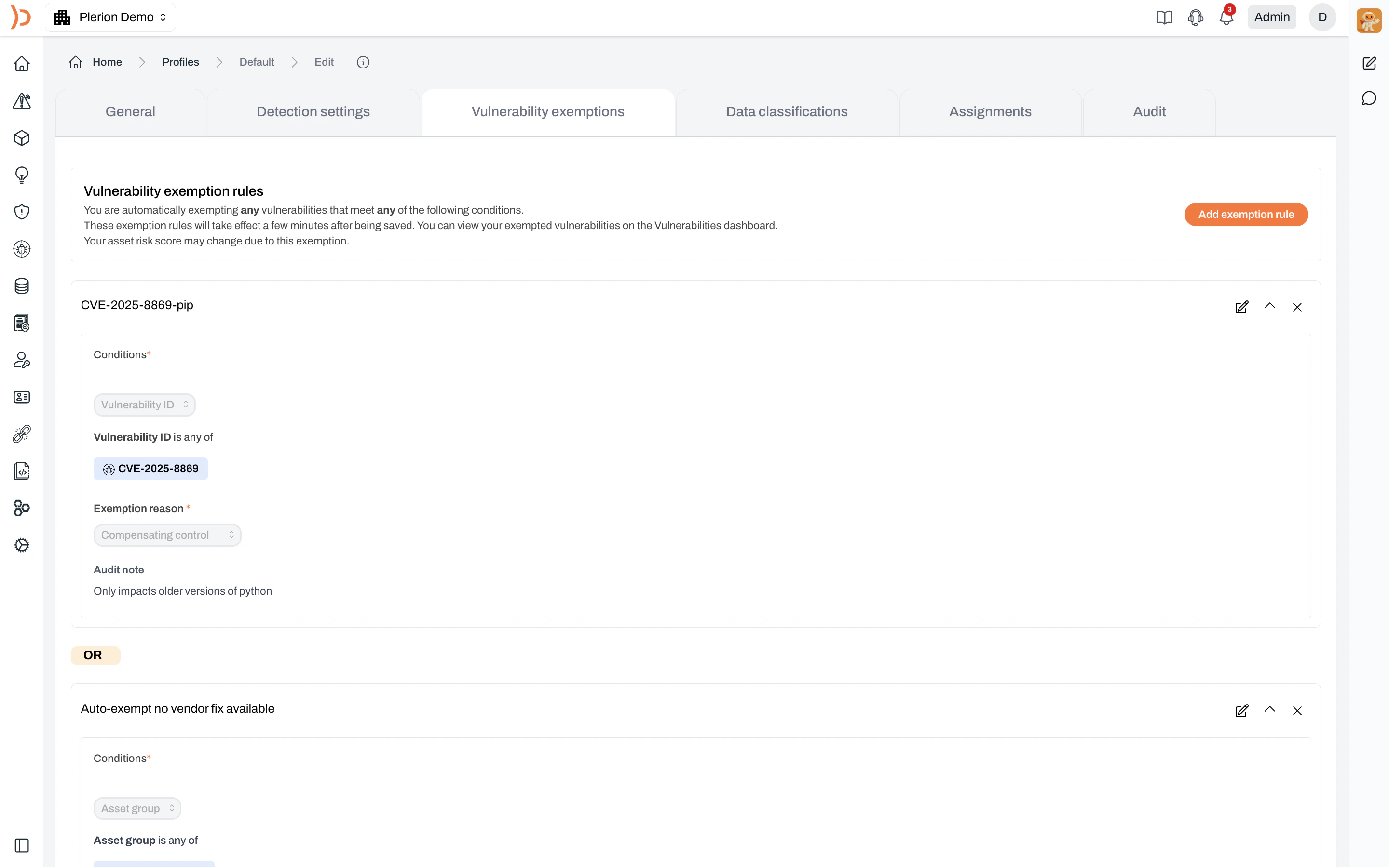
Create exemption rules button in the top right. This takes you to the profile’s Vulnerability exemptions tab where you can define rules.2
Click Add exemption rule
Click the
Add exemption rule button in the top right to create a new rule.3
Configure the exemption rule conditions
Each rule requires:
- Conditions — Define which vulnerabilities match. Available condition types include:
- Asset group
- Asset name/ID
- Asset region
- Asset tag
- Exploit exists
- Exploited vulnerability
- No vendor fix
- Vulnerability ID
- Exemption reason — Select from Accepted risk, Compensating control, No vendor fix available, Not in use or Other reasons
- Audit note — A short explanation for audit purposes
4
Save the profile
Multiple exemption rules within a profile are connected with OR logic — a vulnerability is exempted if it matches any of the defined rules. Exemption rules take effect a few minutes after being saved.
Profile-based exemption rules apply automatically to all vulnerabilities matching the conditions. Your asset risk score may change due to these exemptions.